
Clear thinking
on AI change.
From the inside out.
Articles written from operational experience, not research synthesis. What AI change actually looks like inside organisations, and what to do about it.
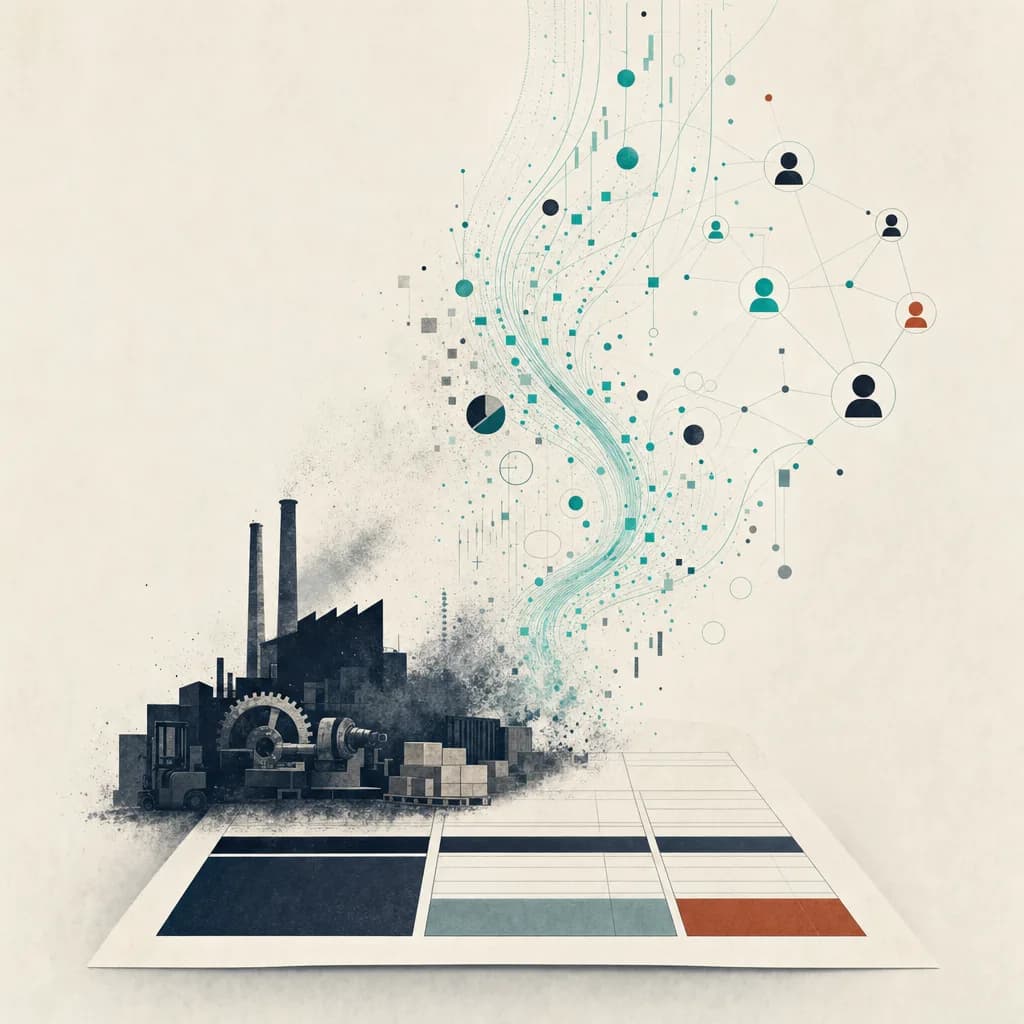
The assets that drive most enterprise value today are invisible on balance sheets, and the frameworks CFOs use to defend valuations were built for a world that no longer exists.
Read articleThe balance sheet records the server. It does not record what runs on it.
This is the kind of thinking Contxtyfy brings into discovery conversations: specific, plain-spoken, and grounded in what work actually costs people.
Published thinking.
SpaceX-xAI, Anthropic, and OpenAI are filing for IPOs within weeks of each other, carrying valuations that rival national GDPs, losses that would sink most companies, and governance structures that have never been tried before.
Three successive disciplines, prompt engineering, context engineering, harness engineering, each solved a real bottleneck the last one could not reach, and the progression tells you exactly where autonomous AI systems are headed.
A concentrated executive layer deploying fleets of autonomous agents has made headcount the wrong unit of organisational scale; here is the engineering that makes it work.
Enterprise technology has crossed a structural threshold: software no longer waits for instructions, and the frameworks built to govern tools that do are now the primary source of competitive and operational risk.
Ninety-two percent of executives expect autonomous AI agents to deliver ROI within two years; more than 80% of the operational data those agents need remains ungoverned, unstructured, and effectively invisible.
Agentic AI costs far more to run than to pilot, and the gap between those two numbers is where enterprise AI strategies go to die.
Early adopters report genuine, sometimes dramatic productivity gains from AI agent architectures, but the numbers behind those gains demand far more scrutiny than the hype allows.
Autonomous agents with read-write-execute access across enterprise systems demand a rigorous, layered governance architecture that no traditional IT framework was built to provide.
The US government's order to shut down Anthropic's most powerful AI models is less a security decision than a political one, and its consequences will reshape the global AI race.
For a $50 million company, the savings are real, the math is straightforward. The difference between capturing 2x and 50x is something most leaders overlook: the Human Throttle.
The qualities my assessments celebrate nearly cost me everything. What Canngea taught me about self-knowledge, blind spots, and why they make you better at AI change work.
Clarity in Complexity
A field guide to AI governance in Australia — and the work of making the frameworks operational.
- Seven layers of Australian AI governance, mapped
- The three obligations already running in 2026
- A five-phase engagement model you can adapt
When they're ready.
Not when the calendar says.
Contxtyfy is not trying to become a content machine. New pieces are published when there is something useful to say.