
The Payoff First: What Terminal-Level Control Actually Means
The enterprise has spent two decades measuring itself in headcount. Org charts, capacity plans, hiring forecasts, span-of-control ratios: all assumed that output and people moved together, that to process more you simply added more. That assumption is now structurally wrong, and the organizations recognizing this earliest are pulling away from those that do not.
The shift is not AI adoption in the broad, ambient sense of deploying copilots and summarization tools. It is something more specific: the decoupling of output from headcount through a concentrated orchestration layer. A small number of people, operating at what practitioners call the automation frontier, direct fleets of autonomous agents across operational domains. Output scales with leverage, not labor. As one framework puts it, the old org chart "assumes that output scales with headcount. More people equals more output. But with frontier operations, you're inverting this. Output scales with leverage and leverage scales with how well a small number of humans operate at that boundary."
The archetype this produces is the frontier engineer. The title matters less than the function: boundary sensing, failure-model maintenance, attention calibration across agent workflows, and socializing changes through the business. The role is a distinct specialty, not a rebranded senior developer. And the output is measurable: a single frontier engineer running multiple agent workflows across a domain produces what a five-to-ten person team produced a few years ago. That ratio, 1:5 to 1:10 and climbing, is the operative metric. FTE count becomes a lagging indicator. The leading indicator is compute-to-output ratio: how much productive capacity a given orchestration layer generates per unit of human attention devoted to running it.
The 100x claim, in its concrete form, is a structural consequence of architecture. Anthropic and OpenAI have already recognized where the value concentrates; both are moving down the stack from model providers toward deployment companies, embedding engineers directly inside enterprises to accelerate the transition. Private equity and hyperscalers are following the same signal.
The pod, not the department, becomes the organizational unit that matters. A small cluster of frontier engineers sitting at the terminal layer, directing agent fleets across accounts payable, compliance documentation, tier-1 support, procurement processing: this is the geometry of the 100x enterprise. Everything downstream, the routing infrastructure, the memory architecture, the governance layer, exists to make that geometry stable under operational load.
Dynamic Routing: The Arbitrage Engine Under Every Workflow
Stable fleet economics rest on a foundation most architecture diagrams omit: the routing layer that decides, in real time, which of 200-plus available models handles each request. Get this wrong and the cost curve inverts. A frontier model billed at frontier prices for a simple classification task is not a performance choice; it is a tax on poor engineering.

Static routing fails structurally because production traffic does not behave like a benchmark. Query complexity, latency tolerance, and cost constraints vary request by request, and a rule written at deployment time cannot adapt to that variance. The result is a fleet that either overspends on capable models applied to trivial work or undershoots on complex tasks routed to lightweight models by a policy that cannot read context. Neither failure announces itself immediately; both compound quietly across millions of calls.
Dynamic routing solves this by analyzing the request itself. Systems like Inworld Router evaluate query complexity, latency requirements, and cost constraints in real time, then select the optimal model without requiring the developer to specify one. A classification task routes to a lightweight model; a multi-step reasoning problem routes to a frontier model. The developer writes to a single API endpoint covering 200-plus providers from OpenAI, Anthropic, Google, Meta, Mistral, DeepSeek, and others. The arbitrage happens below the application layer, invisible to the calling code.
The economics become concrete at the engineering qualification level. Senior practitioners are now expected to calculate blended task costs across multiple models, accounting for continuously shifting provider pricing. The exercise is tractable: build a spreadsheet that models a 100-million-token task across six models simultaneously and watch the cost differential materialize as a number rather than an intuition. That skill, knowing where a task sits on the complexity map and choosing the model tier accordingly, separates engineers who operate fleets profitably from those who operate them expensively. Paying frontier prices for narrow tasks is waste, not caution.
Speed matters as much as cost. Bifrost, one of the leading gateway implementations, runs with 11 microseconds of overhead at 5,000 requests per second. That is effectively transparent latency. Its adaptive load balancer recomputes provider weights every five seconds using error rates, current latency, and utilization metrics, so the routing decision always draws from a live picture of provider health rather than a stale configuration. Automatic failover requires no code changes when a provider degrades; traffic reroutes instantly.
Semantic caching adds a second compression layer. Where exact-match caching returns a stored result only when two prompts are character-identical, semantic caching uses vector similarity to recognize equivalent meaning across differently worded queries. Kong AI Gateway reports up to 20x faster response times on cache hits. At fleet scale, where many requests are functional variants of a small set of underlying intents, this transforms the cost and latency profile of an entire application tier.
The aggregate effect is visible in production data. Wishroll sustained 20x user growth while holding unit economics stable, because the routing layer matched model spend to actual task requirements rather than defaulting to the most expensive option available. The LLM middleware gateway segment is growing at a 49.6% CAGR through 2034, with roughly 42% of enterprises already running a middleware layer. For any organization running agent fleets at meaningful volume, the routing layer is the economic engine that determines whether the 100x output claim translates into 100x margin or merely 100x spend.
Memory That Survives Day 300: Vector Stores, Knowledge Graphs, and Governed Hybrids
Routing solves the cost problem. Memory solves the continuity problem. They are distinct failures, and confusing them is expensive.

An agent that routes brilliantly on day one can collapse by day 300 if its memory layer is poorly structured. The failure mode is not a model limitation; the model performs exactly as designed. The problem is architectural: the agent draws from a memory system that has grown stale, contradictory, or ungoverned, with no mechanism to detect this. It keeps answering, fluently and incorrectly.
Gartner predicts 40% of enterprise applications will integrate AI agents by end of 2026. That adoption curve is an architectural forcing function. Organizations that select memory infrastructure casually in year one will inherit compounding technical debt by year three, because memory choices determine what an agent can know, how reliably it can know it, and who is permitted to ask.
The two dominant architectures each solve a real problem and fail on a different axis.
Vector databases store content as high-dimensional embeddings and retrieve semantically similar results via approximate nearest-neighbor search, delivering sub-millisecond retrieval at scale with zero cold-start cost. An agent can query a vector store the day it is deployed. Retrieval is fast and semantically rich. The structural weakness appears later: vector stores carry no governance primitives. There is no notion of data ownership, access control, certification status, or compliance policy. Any agent with index access sees all retrieved chunks regardless of who owns the underlying data. When source systems change while embedding pipelines update asynchronously, the store has no staleness signal; the agent surfaces outdated information with full semantic confidence.
Knowledge graphs invert this tradeoff. They model typed entity relationships and support deterministic multi-hop traversal: explainable, auditable, capable of answering not just "what is this?" but "how does this connect to that, and through whom?". For enterprise contexts involving regulatory data, org structure, or supplier relationships, that traversal capability is not a luxury. The cost is substantial upfront engineering to establish ontology and entity relationships, plus ongoing maintenance as the organizational model evolves. Cold-start is real. An organization cannot deploy a knowledge graph on Monday and expect production-quality retrieval by Friday.
Temporal knowledge graphs push the architecture further. Zep's Graphiti implementation attaches validity intervals to every edge, recording when each relationship became true and when it was invalidated. On temporal reasoning tasks, this approach achieves 18.5% higher accuracy than architectures without time-aware edges. For any domain where the answer depends on when the question is asked, that gap compounds across millions of agent interactions.
The current production standard for complex enterprise agents combines both approaches, with a governed metadata graph handling organizational context, access controls, and freshness guarantees as a separate layer. The vector store handles fast semantic retrieval; the knowledge graph handles relationship traversal; the metadata graph enforces who can see what and flags stale sources before they reach the model. Scaffolding external memory stores into agent architecture is what separates a prompt-level prototype from a system with genuine organizational durability.
The failure mode most organizations encounter is sequential rather than simultaneous: they build with a vector store for speed, ship fast, and defer governance. By month six, the index contains confidential data retrieved without access control, stale pricing information delivered with full fluency, and no audit trail. Retrofitting governance onto a vector store is structurally harder than building it in from the beginning, because governance requires knowing the provenance and ownership of every chunk, information that pure embedding pipelines discard.
Memory architecture is not a back-end detail. It is the difference between an agent that accumulates operational knowledge over time and one that quietly degrades while appearing to function. The agents producing at scale on day 300 are the ones whose memory systems were designed, not inherited.
First Principles: Rebuild the Process at the Data Layer
The agents that survive to day 300 do so because someone, before writing a single line of deployment code, asked a harder question than "which workflow should we automate?" They asked what the workflow actually is at the data layer, stripped of the organizational folklore that has accumulated around it.
Most enterprises skip that question. They map an existing process, identify its most repetitive steps, and hand those steps to an agent. The machinery is new; the process shape is old. The result is an automated version of a broken workflow, faster and more expensive to maintain than the human version it replaced. The technology performed correctly. The diagnosis was wrong.
The correct sequence begins with expertise elicitation. Before deployment, an agent's first job is to interview the people who hold operational knowledge they cannot articulate unprompted. Not a survey, not a process map review: a structured interrogation that asks the right questions in the right order with the right follow-ups, extracting the judgment rules, exception patterns, and edge-case handling that experienced operators carry but cannot self-report. That tacit knowledge is what makes a workflow function. Without it, an agent inherits the visible skeleton of a process and misses the connective tissue.
Once that knowledge is surfaced, the workflow can be classified. The four-quadrant model does this work cleanly. High-volume, low-judgment tasks belong in the first quadrant: full automation, no apology. Accounts payable, compliance documentation, tier-1 support, data entry, procurement processing, HR administration. These are the enterprise functions where a single agent deployment handles the volume equivalent of two to five FTEs, not because the technology is impressive but because the judgment requirement is genuinely low and the volume is genuinely high. The second quadrant holds high-volume, moderate-judgment work: augmentation rather than replacement, with agents improving human throughput 40 to 70 percent, each FTE now producing at the rate of 1.4 to 1.7. Low-volume, high-judgment work sits in the third quadrant, where AI assistance adds value but human decision authority remains structural. The fourth quadrant, low-volume specialized expertise, offers no near-term substitution case worth making.
The classification matters because it forces a function-level workflow analysis most organizations avoid. Those that skip it deploy in isolated pockets, automating the easiest visible task in each department without building an integrated capacity model. The gains are real but sub-linear; the architecture stays fragmented.
Rebuilding from the data layer means treating the enterprise as a data-shaped problem first. Agents are not, by default, data organizers. Without explicit constraints, without guard rails that require them to respect existing data schemas, they produce messy outputs that compound into structural debt. The agent that handles purchase orders on day one will handle them on day 300 only if the data environment it operates in was designed to stay clean. That design is not an agent capability. It is prior infrastructure work, done by humans before deployment begins.
The failure mode, repeated across industries, is good technology applied to a process that was never examined at its foundations. The old shape accepted human improvisation as a hidden load-bearing element. Agents cannot improvise the same way. They execute what the data and the rules actually say, which means the data and the rules must, for the first time, be exactly right.
Safety at Fleet Scale: Governance, Exception Handling, and Hard Limits
Exact rules produce exactly the wrong outcomes when the rules themselves are wrong. That is the governance problem at fleet scale, and it runs deeper than compliance.
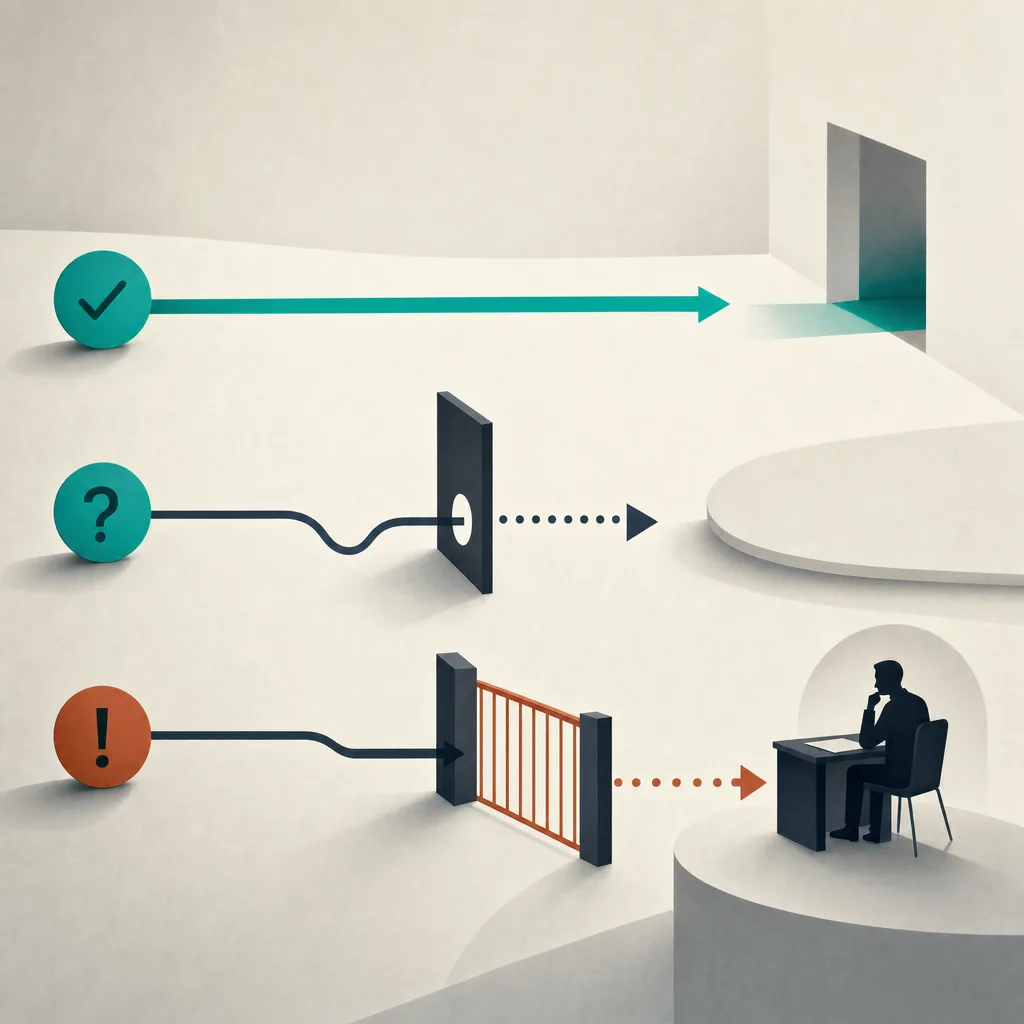
A single misconfigured agent executing one bad action is a bug. A fleet of agents executing the same bad action across every workflow simultaneously is a structural failure. The difference is not degree; it is kind. Governance at fleet scale is the engineering discipline that keeps those two failure modes distinct, and enterprises that treat it as a checkbox encounter the distinction expensively.
The architecture starts with classification. The tiered model separates actions into three categories: safe actions that execute without interruption, side-effect actions that log warnings and create state checkpoints before proceeding, and irreversible actions that halt the agent entirely until a human approves. The key engineering move is pushing that classification from prompt instructions into the infrastructure layer. Tagging a tool as irreversible does not ask the model to remember a constraint; it physically stops execution until approval arrives. The model's instruction set is a suggestion. The infrastructure tag is a hard limit.
Human-in-the-loop oversight fits inside this architecture as a structural element, not as evidence that automation fell short. Amazon Bedrock Agents offer two distinct patterns. User confirmation pauses at the individual function level and collects a Boolean approval before the agent continues; overhead is minimal, the guarantee is absolute for that specific action. Return of control operates at the action group level, hands the developer the agent's full proposed parameter set, and allows modification before execution proceeds. Return of control is the right pattern when the cost of an incorrect parameter is high and the user has context the agent cannot access; user confirmation is the right pattern when the action is discrete and the only question is whether to proceed. Deploying both indiscriminately reintroduces the latency fleet operations exist to eliminate. Deploying neither is how a 3.2% false negative rate in a healthcare claims processing agent runs uncorrected for 23 days, producing 1,847 wrongful denials and $2.1M in remediation costs.
Centralized policy engines are what make human-in-the-loop patterns governable across a fleet rather than idiosyncratic per deployment. When a compliance team updates a PII detection rule through a centralized policy server, that change propagates to every agent in the fleet without code updates, redeployment, or restarts. The separation of ownership matters: developers place the control hooks; compliance teams govern what those hooks enforce. Without that separation, policy is embedded in application code, and updating it requires coordinated engineering work across every agent instance. The fleet becomes ungovernable as it grows.
The cost evidence for inadequate safety architecture is concrete. A travel platform that reduced support headcount by 40 percent and concentrated its LLM dependency in a single provider discovered that concentration during an API outage: complete system failure, $2.1M in customer remediation, and $600K in emergency contractor capacity. Simultaneous multi-department rollouts, which bypass the staged deployment logic that isolates failure domains, produce median costs of $8.9M and five-month rollback timelines. These are not edge cases. Simultaneous multi-department deployment accounts for 15 percent of observed enterprise agent failures.
The regulatory clock adds external pressure to what is already an internal engineering imperative. The EU AI Act's Article 14 sets August 2, 2026 as the compliance deadline for high-risk AI systems, mandating human-machine interface tools that enable effective oversight by qualified persons. Gartner's projection sharpens the stakes further: by 2030, half of all AI agent deployment failures will trace back to insufficient governance platform runtime enforcement. The gap between the 62 percent of enterprises experimenting with agents and the 23 percent successfully scaling them reflects, in part, governance architecture built for experimentation and never hardened for production.
The human-as-exception-handler model, where agents operate autonomously within defined policy boundaries and escalate only when they encounter unmapped scenarios, is the steady-state target. Reaching it requires that policy boundaries were drawn correctly before deployment, that classification tiers are enforced at the infrastructure level, and that feedback from human corrections flows back into the system's retraining pipeline. Governance is not the lid on autonomous operation. It is the container that makes autonomous operation at scale possible at all.
The Transition Gauntlet: Infrastructure, Talent, and the Change Management Trap
Building the governance container is necessary but not sufficient. The transition from experimentation to scaled fleet operation carries its own structural tax, paid in infrastructure dollars, integration weeks, and organizational friction that most deployment plans never price in.
The infrastructure investment spans a wide range. A successful first use case, covering 100 to 500 users, runs $180K to $420K at the median; failed deployments cost three to eight times more. Legacy integration is where budgets collapse most visibly. One documented enterprise integration project was scoped at 12 weeks and $680K. The actual timeline ran 31 weeks. The final bill was $4.1M. That 2.6x timeline overrun and 6x cost overrun is not an outlier; it reflects a recurring failure to account for the brittle, undocumented interfaces holding together systems built across decades. The integration layer does not forgive optimism.
Sequencing determines whether these costs yield a functioning system or an expensive rollback. Staged deployments, run over six to nine months with deliberate scope boundaries, succeed 78% of the time. Big-bang rollouts succeed 31% of the time. Enterprises that compress deployment below four months experience a 54% failure rate. The arithmetic is not subtle: speed into deployment is a mechanism for destroying capital.
The person who manages this transition correctly is not a generalist program manager. The frontier engineer is a distinct specialty, with total compensation clearing $400K at the senior level and demand exceeding supply. What distinguishes the role is not deep knowledge of any single model but the capacity to operate across model selection, cost arbitrage, failure boundary sensing, and organizational change simultaneously. One frontier engineer running multiple agent workflows across a domain produces output that previously required a five-to-ten person team. That leverage ratio is the point. The skill set combines systems architecture with the operational judgment that only emerges from having managed live failures, which is why the role is scarce.
Change management failure, not technical failure, is the primary cause of AI agent deployment collapse in enterprises. The inventory forecasting case makes this concrete. An agent achieved 89% accuracy against a 78% manual baseline. By any technical measure, it worked. Store managers abandoned it anyway, because the system could not explain its reasoning and operators were never brought into its design. The technical win became an organizational loss. Deployments with explicit commitments against layoffs showed 31% higher adoption rates than those without, which suggests that workforce anxiety, left unaddressed, routes itself into system rejection.
Reskilling is the structural work that makes the exception-handler model viable rather than theoretical. When agents handle volume and humans handle exceptions, the humans handling exceptions must actually be capable of handling them, which requires role redefinition, structured reskilling pathways, and phased deployment sequencing that allows teams to build competence before the exception load arrives. Skipping this step does not save time. It produces a system where agents escalate correctly and the humans on the receiving end lack the context or training to resolve what lands in their queue. The automation boundary holds; the human layer behind it does not.
The Pod Model and Its Ceiling: What Comes After the 100x Claim
The 100x claim holds, but only inside its actual boundary conditions. Agents produce at 100x. Humans review at 3x. That asymmetry is not a temporary calibration problem; it is a structural ceiling on throughput, because the review layer cannot compress indefinitely without degrading the judgment quality that justifies having humans in the loop at all. The architecture produces volume the oversight layer cannot clear. Fleet size, left unchecked, manufactures a backlog.
The FTE equivalence numbers sharpen this. Fully automated Quadrant 1 workflows yield 2 to 5 FTE equivalents per agent deployment. Quadrant 2 augmentation, where human judgment remains load-bearing, improves individual throughput by 40 to 70 percent, meaning each human becomes 1.4 to 1.7 humans, not ten. The multiplier compresses fast as exception density rises. In exception-heavy domains, the agent fleet routes escalations upward continuously, and the humans at the top of the queue become the binding constraint. The 100x figure belongs to the high-volume, low-judgment quadrant. Outside it, the number shrinks toward something more like 2x, which is still real value but is not the architecture-reshaping claim that anchors the model.
Regulatory ceilings are harder still. FDA review, financial audit, certain categories of legal determination: these are not workflows awaiting better models. They are jurisdictional limits where human accountability is the product, not an implementation detail. Regulated industries operating with proper compliance architecture can still reach 50 to 70 percent of the efficiency gains available in less regulated environments, but the ceiling is set externally and does not move on an engineering timeline. The EU AI Act's August 2026 deadline will formalize some of these limits in ways enterprises are only beginning to map. An agent cannot clear FDA review not because it lacks capability but because the regulatory structure requires a credentialed human to bear liability for the determination.
The steady-state ratio of frontier engineers to fleet size remains genuinely open. A single frontier engineer producing output equivalent to a five-to-ten person team is a useful benchmark for now. Whether that ratio holds at larger fleet sizes, or whether coordination costs, failure model complexity, and governance overhead eventually flatten the leverage curve, is a question the current generation of deployments has not yet lived long enough to answer.
The Chief Automation Officer model, the frontier engineer archetype, the tiered governance stack, the hybrid memory architecture: these are the best current answers to a problem the industry has been running seriously for roughly eighteen months. The architecture described here is not a finished structure. It is a live construction, stress-tested at scale for the first time, and the enterprises building on it today are simultaneously its engineers and its proof of concept. The 100x enterprise exists. Its ceiling has not yet been found.