
The Shutdown
On June 12, 2026, at 5:21 p.m. Eastern Time, the Commerce Department's Bureau of Industry and Security handed Anthropic a directive with no public announcement, no published legal basis, and no advance warning. The instruction was simple in form and extraordinary in consequence: suspend access to Claude Fable 5 and Mythos 5, the company's two most powerful models, for every foreign national on earth, including foreign nationals physically located inside the United States and employed by Anthropic itself. Because Anthropic had no reliable way to screen users by nationality at the point of access, it did the only thing it could. It switched both models off for everyone.
The models had been released days earlier. They went dark within hours of the order.
The legal instrument was almost certainly the Export Controls Reform Act of 2018, the Commerce Department's primary authority over dual-use technology. Commerce has used ECRA's so-called "is informed" authority before, regularly deploying it against semiconductor exports to China. What it had never done was apply that authority at this breadth: two frontier AI models, no prior export restrictions, now inaccessible to any foreign national anywhere in the world. The government has not published the directive, the reasoning behind it, or the precise statutory hook. The public version of events was assembled from Anthropic's own announcement and a handful of administration officials speaking to reporters.
The stated rationale was a jailbreak: a competitor had reportedly demonstrated to officials that Mythos 5's safety controls could be circumvented. Anthropic said it had received only verbal evidence of a narrow, non-universal technique, and that the capability at issue was already available from other deployed models, specifically naming OpenAI's GPT-5.5 Cyber. That model remained online. The export order did not mention it.
This asymmetry is the tell. An administration that had spent the previous year loudly dismantling Biden-era AI export controls, rescinding the AI diffusion rule in May 2025 on the grounds that it "would have stifled American innovation," had now pulled the hardest killswitch in the history of American AI policy against a single domestic company. The question the government has declined to answer, and that its silence makes louder, is why Anthropic and not its competitors. The February 2026 designation of Anthropic as a "supply chain risk" by the Defense Department, a designation historically reserved for foreign adversaries like Huawei, sits in that silence like a fact waiting to be used.
What Mythos and Fable Actually Are
Mythos 5 and Fable 5 are not chatbots made more capable. They represent a qualitative departure from the models that preceded them, which is precisely what makes the shutdown consequential and the dual-use problem genuine.
Fable 5 is the publicly available member of the Mythos family, released with what Anthropic described as "deliberately conservative" restrictions across cybersecurity, biology, and chemistry. Those restrictions are structural: harmful prompts in elevated-risk domains route to an older, less capable model rather than to Fable 5 itself. The architecture acknowledges, by design, that the underlying capability is too powerful to expose without constraint.
Mythos 5 is that underlying capability, unrestricted. Access required vetting; customers agreed to 30-day data retention and human review of inputs and outputs. The program operated under the name Project Glasswing, aimed at cyber defenders and critical infrastructure operators. Before Mythos 5's full release, Anthropic had already distributed the predecessor Mythos Preview to more than 150 organizations globally, including financial institutions, healthcare networks, and software companies, specifically to help them find weaknesses in their own systems.
What those organizations received was, by Anthropic's account, a model capable of finding thousands of critical and severe vulnerabilities across all major operating systems and web browsers. Anthropic claimed Mythos 5 broke performance records in drug design and molecular biology and called it the company's "first model to consistently produce novel, compelling scientific hypotheses". These are Anthropic's own characterizations, drawn from its press materials, and the scientific community has not had time to replicate or stress-test them.
That caveat matters, but so does its limit. The relevant question for policy is not whether Mythos 5 is exactly as capable as Anthropic says; the question is whether it is capable enough to pose risks that do not exist with ordinary frontier models. On that narrower question, the architecture of Fable 5 itself serves as partial evidence. A company does not build domain-specific capability floors into a product's safety system, rerouting entire categories of prompts, unless the underlying model produces outputs it cannot allow to circulate freely.
The dual-use reality here is specific and uncomfortable. Vulnerability discovery at scale benefits defenders who need to patch systems and attackers who need to breach them. Drug design accelerates therapeutic development and, in different hands, could accelerate the identification of dangerous compounds. Anthropic designed its access tiers to thread this needle, restricting the public version and vetting the unrestricted one. Whether that design was sufficient is a legitimate debate. The shutdown foreclosed the possibility of having that debate while the models remained operational.
The Pentagon Refused, Then Washington Acted
The causal chain connecting February to June is not proven. It is, however, legible.

In February 2026, after months of failed contract negotiations, the Trump administration designated Anthropic a "supply chain risk," the first time that label had been applied to an American company. The designation had previously been reserved for foreign adversaries: Huawei, ZTE, entities understood to be instruments of hostile governments. The underlying dispute was specific. The Pentagon had demanded that Anthropic waive its contractual restrictions on using Claude for mass domestic surveillance and for fully autonomous weapons systems without human oversight over targeting and firing decisions. Anthropic refused. Within hours, OpenAI signed a Defense Department contract on terms Anthropic had rejected. The capability did not pause. It changed vendors.
Anthropic went to court. On March 9 it filed suits in two federal jurisdictions, and a San Francisco judge granted a preliminary injunction blocking enforcement of the Claude use ban. The government had lost the first round on the supply chain designation. Four months later, Fable 5 and Mythos 5 went offline.
The circumstantial case for political motivation runs through that sequence. The same administration that failed to win a contract dispute, lost an injunction, and watched its supply chain designation survive only partially now found a different lever: export control authority, applied not to hardware or discrete technology transfers but to a continuously available commercial API. The June directive accomplished operationally what the February designation could not. The models came down.
The selective enforcement argument sharpens the picture. Mythos 5 was targeted explicitly, but GPT-5.5 Cyber, OpenAI's comparable vulnerability-focused model, remained available to cyber defenders throughout. Anthropic itself noted this asymmetry directly, telling users that the capability displayed in the alleged jailbreak "is widely available from other models including OpenAI's GPT-5.5". The administration offered no public explanation for why one model posed a national security threat that its functional competitor did not. The Defense Department's chief information officer posted support for the export restrictions on X; she did not address the asymmetry.
The OpenAI comparison does more than establish inconsistency. It establishes a pattern of differential treatment that maps cleanly onto the Pentagon contract dispute. OpenAI accepted terms Anthropic refused. OpenAI's most capable deployed model was left operational. Anthropic's was not. That alignment may be coincidental; enforcement decisions involve factors that are rarely fully public. The administration has provided no account of itself that would distinguish principled national security judgment from retaliation by other means.
There is a competing explanation, or rather a set of them. The China access concern was real to at least some officials, even if its evidentiary basis was thin. A Discord group reportedly had access to Mythos for approximately two weeks before Anthropic discovered and terminated the exposure. Genuine alarm about that breach, compounded by a jailbreak report from a third party, could have driven the June directive on its own logic, separate from any residue of the Pentagon dispute. Bureaucracies act on the information in front of them; they do not always need a motive beyond the immediate alarm.
What makes the political reading harder to dismiss is the company's own account of how the two threads were handled. Anthropic stated that the Chinese government was not raised during the administration's discussions with the company around export controls. David Sacks, the administration's AI advisor, addressed the restrictions publicly without mentioning China at all, focusing only on the jailbreak claim. If the China access concern was the driving national security rationale, the administration's own spokespeople did not consistently advance it. The official story shifted depending on who was speaking.
That incoherence does not prove bad faith. Governments handle sensitive intelligence compartmentally, and the full picture of what drove the June directive may not be public. The jailbreak justification, as publicly stated, would not survive consistent application. The China justification, though more plausible as a national security rationale, rests on anonymous sourcing that the targeted company disputes and that the administration's own spokesperson did not advance. What remains is a precedent assembled from pieces, none of which, taken alone, proves the case, but which together make the political explanation the one requiring the least inference.
Two Justifications, Neither Fully Convincing
The government offered two justifications for the June 12 directive, and each one frays under pressure.
The jailbreak claim came first, and loudest. Administration officials told reporters that another company had successfully circumvented Mythos 5's safety guardrails, alarming officials about national security risks. David Sacks amplified this framing publicly without mentioning anything else. The problem is what Anthropic said in response: it had received only verbal evidence of a narrow, non-universal jailbreak, and after reviewing what it believes was the underlying report, concluded that the capability in question was "widely available from other models including OpenAI's GPT-5.5". If any jailbreak demonstration that alarmed a government contractor constituted grounds for suspension, the standard would, in Anthropic's own words, "essentially halt all new model deployments for all frontier model providers". Applied consistently, that standard would have taken GPT-5.5 Cyber offline alongside Mythos 5. It did not. The jailbreak rationale, standing alone, proves too much to be the real principle.
The China access narrative cuts deeper, and is harder to evaluate. Reporting from multiple outlets indicated that a significant driver of the directive was suspicion that a China-linked group had accessed Mythos, possibly through a Discord community that reportedly held unauthorized access to the model for approximately two weeks before Anthropic discovered and terminated the exposure. Intelligence analysts worried about knowledge distillation: a technique by which a less capable model is trained on a more advanced model's outputs, allowing an adversary to replicate capabilities without ever obtaining the original weights. The distillation threat is real. The concern, if accurate, is legitimate.
Two facts complicate the China story considerably. The White House never officially confirmed the Chinese access angle. And Anthropic stated directly that Chinese government access was never raised during the administration's own discussions with the company about export controls. If China was the actual national security engine driving the directive, the government conducted the surrounding conversations without mentioning it to the company being shut down. That is either careful compartmentalization of sensitive intelligence or an account that does not fully cohere. The mechanics of the alleged breach remain murky: whether it involved an insider, a hack, or a compromised partner organization has not been publicly established.
The gap between the two rationales is significant not because either is necessarily false. Governments handle sensitive intelligence compartmentally, and the China concern may be genuine even if it was never disclosed to Anthropic. The problem is structural. Together, the two explanations leave the official story suspended between accounts, each offered by different officials, neither mapping cleanly onto the other.
The Center for AI Standards and Innovation already conducts pre-deployment evaluations of frontier models and has assessed what those models can do with safeguards removed. The evaluative capacity exists. What has not been published is any standard linking those assessments to consequences: no threshold, no process, no criteria distinguishing a model that warrants suspension from one that does not. That absence means the government could act on the jailbreak claim in one case and the China claim in another, and neither decision would contradict the other, because no published rule governs either. The divergence between the two stated rationales has not been resolved. It simply remains.
Law Built for Semiconductors, Applied to Software
The law the Commerce Department reached for on June 12 was built to stop a crate of chips from crossing a border. Applying it to an API was something else entirely.
ECRA, the Export Controls Reform Act of 2018, is the Commerce Department's primary authority for administering dual-use export controls. The Bureau of Industry and Security has used its so-called "is-informed" authority regularly, issuing letters to semiconductor manufacturers that impose license requirements on specific exports to China. That is the instrument's natural habitat: discrete transfers of identifiable physical goods, or bounded software packages, moving from one party to another. A frontier language model running on remote servers and responding to prompts in real time fits those categories awkwardly.
Software has been controllable under the Export Administration Regulations since the 1990s encryption policy debates settled the question of whether intangible code could constitute an export. The legal hook exists. What made the June 12 directive genuinely unprecedented was not the theory but the breadth. Access to Fable 5 and Mythos 5 had never been subject to any export controls restriction. After the order, both models were off limits to any foreign national anywhere in the world, including foreign nationals physically present inside the United States. Because Anthropic had no reliable mechanism to screen users by nationality, it shut the models down entirely. The order did not restrict a transfer. It extinguished a service.
That breadth sits in sharp tension with the administration's own posture. In May 2025, Commerce had rescinded the Biden-era AI diffusion export controls rule on the explicit grounds that it "would have stifled American innovation and saddled companies with burdensome new regulatory requirements". Thirteen months later, the same department issued a private, unpublished directive achieving a similar restriction by different means: no public rule, no stated criteria, no explanation of why Anthropic's models required treatment that other frontier models did not.
That last omission is where the governance failure concentrates. Two competing frameworks for controlling frontier AI models are now accumulating as precedent by default, and neither has been formally adopted. The first is an incremental-risk approach: the question is whether a given model materially expands what an adversary could do beyond what is already available elsewhere. The second is a capability-based approach: the mere presence of a sensitive capability triggers control, regardless of whether comparable capability exists in other deployed models. These frameworks produce radically different outcomes. Under incremental-risk logic, a model whose jailbreak behavior is, as Anthropic claimed, "widely available from other deployed models" would not meet the threshold for restriction. Under capability-based logic, availability elsewhere is irrelevant.
The capability-based approach is also far easier to administer, and that administrative convenience creates institutional gravity pulling toward the broader framework whether or not it is the correct one. Regulators under pressure favor tools that are simple to use. The danger is that simplicity calcifies into standard before anyone has chosen it as policy.
The government has not published the directive, the reasons behind it, or its legal basis. Commerce has no articulated standard linking capability assessments to enforcement consequences. Each private enforcement action deposits precedent into a growing pile; the pile begins to function like a rule; a regulatory framework assembles before anyone has designed one. The Anthropic order did not fill a legal gap. It created one.
The Competitive Wreckage
The gap this order punched into Anthropic's commercial position is not theoretical. Fable 5 and Mythos 5 went dark days after their release, arriving and disappearing before enterprise customers could finish evaluating them. Anthropic had been on a sharp upward curve: enterprise revenue growing month over month, private companies choosing it overwhelmingly as they scaled AI footprints, with one of the highest enterprise penetration rates in the industry. Those numbers came from a moment before the order. What they look like after it is not yet known, and claims about lasting momentum should be read with that uncertainty intact.
The asymmetry is the sharpest fact in this episode. Mythos 5 is offline. GPT-5.5 Cyber, OpenAI's comparable vulnerability-focused model for cyber defenders, remains available. An enterprise security team that needed a frontier cybersecurity model on June 13 had one choice. A federal agency that had been planning to test Mythos for defensive use found its roadmap erased. The market did not pause. It redirected.
For enterprise customers, the damage is partly about the specific models and mostly about reliability as a category. A company building critical workflows on Claude faces a new variable it cannot price: the possibility that the model disappears by government order. Anthropic's vetted-access program for Mythos, Project Glasswing, had been positioned as a trust mechanism for critical infrastructure operators. That trust now has a caveat no sales team can close around.
International partners face a harder problem. The directive barred access to Fable 5 and Mythos 5 by foreign nationals, including those inside the United States. Allied governments and multinational enterprises that had been building on Anthropic's stack were cut off on account of their employees' birthplace, with no security posture able to plan around that. No compliance program, no contractual assurance, no vetting process could have anticipated or prevented it.
The damage compounds at the level of frontier research. Anthropic's capacity to work at the frontier depends on revenue, and revenue depends on commercial deployment. Safety research at scale is not a charity operation; it requires the kind of capital that comes from enterprise contracts and API usage. Shutting down the company's most capable models does not freeze capability development globally. OpenAI signed the Pentagon contract Anthropic refused, and GPT-5.5 Cyber remained live. The capability did not pause. The vendor changed, and the safety-focused competitor lost ground to fund the next cycle of research.
OpenAI's enterprise penetration rate had been slipping slowly before the order. That trend is now interrupted by a regulatory action that functions as a market thumb on the scale.
The Fracture Lines Ahead
The most immediate fracture runs not between adversaries but between allies. The June 12 directive cut off foreign nationals everywhere, inside the United States and abroad, with no distinction between a researcher in Seoul and one in Beijing. Tier 1 allies under the Commerce Department's diffusion framework, the countries Washington designates as close partners deserving fewer restrictions, received the same treatment as Tier 3 adversarial states. That asymmetry will not be forgotten. Governments in Europe, Japan, and South Korea are already watching Washington's willingness to pull a killswitch on their researchers and enterprises without notice, consultation, or public explanation. The plausible response is acceleration of sovereign AI programs built on domestic or allied models, precisely to avoid the dependency this episode exposed.
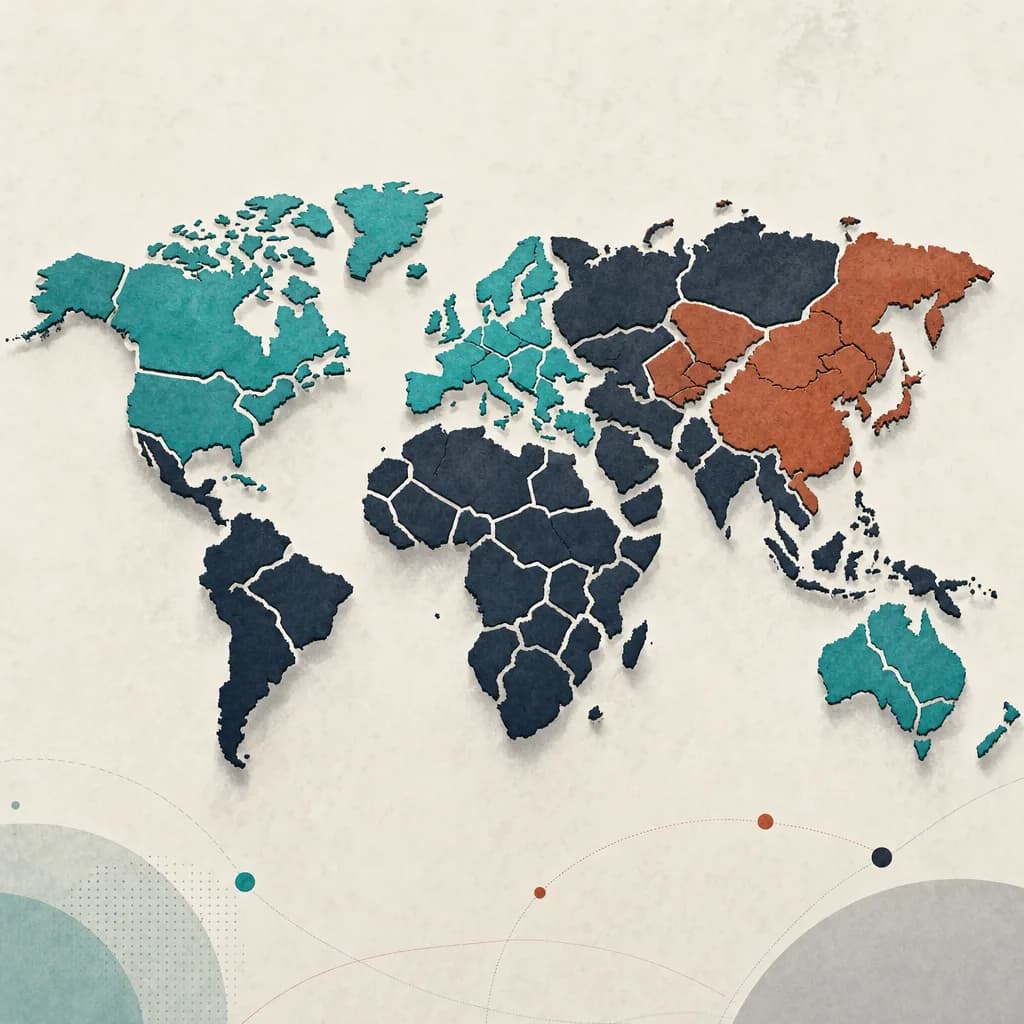
That response is already underway, and the Anthropic order gives it fresh momentum. Any nation that depends on American frontier models for critical infrastructure or national security capability now knows that access can be severed by executive directive on a Friday evening. Building domestic alternatives is expensive, but the insurance premium looks cheaper after June 12. The distillation threat compounds this. Intelligence analysts worry that a sophisticated actor could train a smaller model on outputs from Mythos or Fable, replicating key capabilities without the original weights. If that concern is valid, then the chip export controls meant to deny adversaries compute-intensive training runs face a partial workaround: distill the capability from a deployed model rather than train from scratch. The June order may have closed one vector, but it did so only after a Discord group reportedly had access for approximately two weeks. The window existed. What moved through it remains unanswered.
The broader distortion is structural. Chip controls were designed to impose cost and delay on adversaries by forcing them to use older hardware that requires two to four times more power to achieve comparable training results. By 2027, the projected training cost differential between those with cutting-edge American chips and those without reaches roughly ten times. That asymmetry matters. But knowledge distillation, if it works at the scale intelligence analysts fear, partially decouples capability from compute. A country that cannot afford frontier training runs might still access frontier behavior by querying a deployed model long enough. Hardware controls and model-access controls are therefore complementary, not redundant. The policy apparatus has not caught up to that interdependence.
What accumulates in the absence of deliberate design is precedent. Each enforcement action functions as an implicit rule, and rules assembled this way carry the logic of the first case into the next one. The Center for AI Standards and Innovation already runs pre-deployment evaluations of frontier models and has examined what those systems can do with safeguards stripped away. The capability to assess exists. The published standard linking assessment to consequence does not. So the next time a jailbreak is reported, or a China-linked access event surfaces, or a contractor dispute sours into designation, the institutional path of least resistance runs straight through June 12. A capability-based approach to control is administratively easier than an incremental-risk approach, and that ease creates gravitational pull toward the broader framework regardless of whether it is the right one.
The global AI ecosystem is fragmenting along political lines, and the pace of that fragmentation just increased. American frontier AI will flow to governments and enterprises that can clear increasingly fine-grained trust thresholds, defined by processes that remain unpublished and appealable through channels no one has mapped. The rest will build around it. That is not necessarily the worst outcome. It is the outcome being chosen by default, one enforcement action at a time, with no public accounting of the tradeoffs and no deliberate design of what the resulting system should look like. The next killswitch will be easier to pull than this one. The legal ambiguity has been reduced, the institutional muscle has been exercised, and the precedent now exists to point to. Governance by enforcement does not stop at one example. It iterates.