
The Agents Are Ready. The Data Is Not.
Ninety-two percent of executives expect agentic AI to deliver measurable ROI within two years. The models are capable. The infrastructure is maturing. The bottleneck is something far less glamorous: the data underneath.
Eighty percent of enterprise data exists in unstructured formats, growing at a compounded annual rate of 61 percent. Contracts, emails, regulatory filings, maintenance logs, supplier correspondence. The material that actually tells an agent what is happening in an organization. Less than one percent of it is currently used in any generative AI application. Agents trained to act autonomously are, in practice, operating on a fraction of the evidence they need.
The gap is not a technology problem waiting on a better model. Seventy-one percent of enterprises report that managing and protecting unstructured data exceeds their current capability. Twenty-one percent of all organizational data carries no protection whatsoever. Data science teams spend most of their time preprocessing raw inputs rather than building toward inference. The pipeline is the problem.
What makes this consequential now is the scale of autonomous decision-making enterprises are preparing to hand over. Agentic AI does not retrieve information and wait; it plans, executes, and triggers downstream actions across systems. When the data foundation is ungoverned and largely invisible, those actions compound errors rather than correct them. The agents are ready. The ground they would act on is not.
Where Operational Context Actually Lives
An ERP record for a supplier might list a contract value, a delivery window, and a payment term. What it omits is everything an experienced procurement manager actually reads: the force majeure language buried in clause 14, the email thread where the supplier flagged a component shortage three weeks before the formal notice arrived, the regulatory filing that disclosed a facility relocation. That context does not live in structured fields. It lives in documents, correspondence, and logs that most enterprises have never made machine-readable.
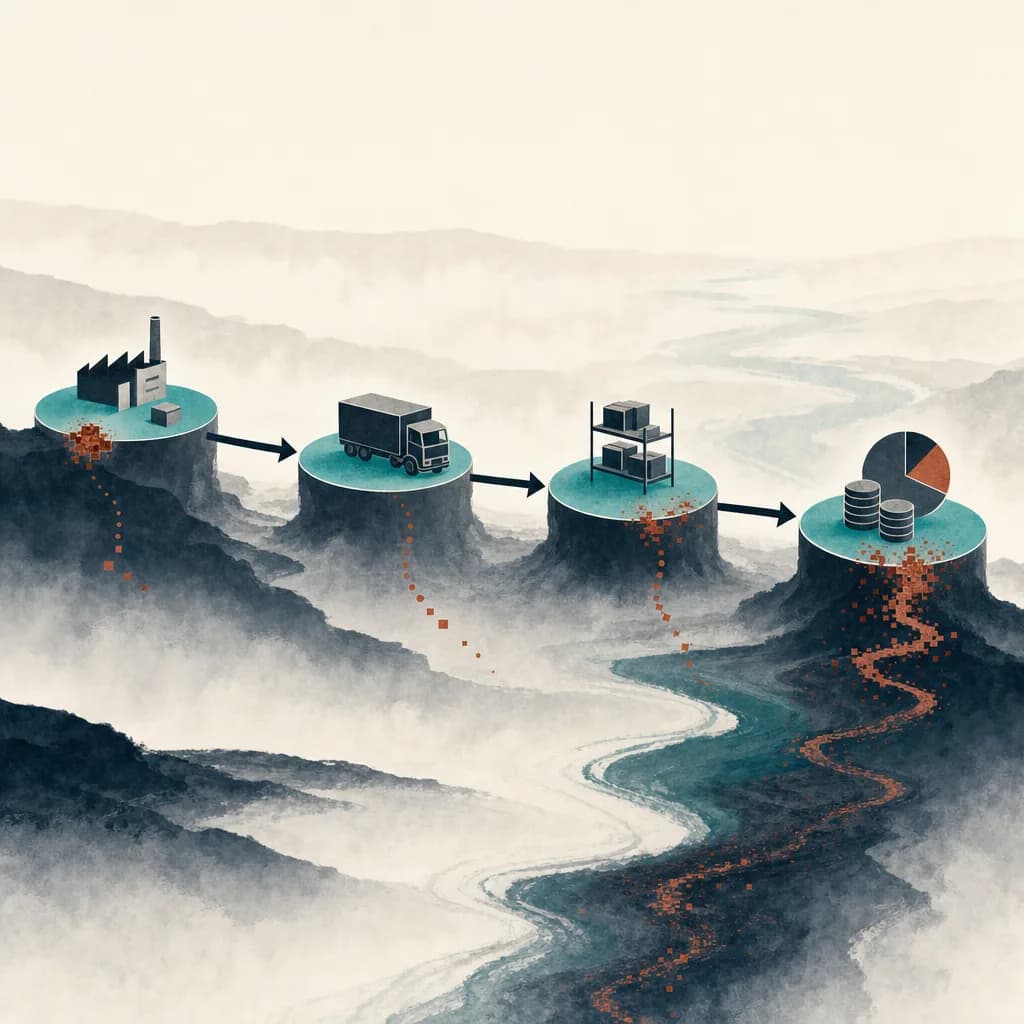
This is precisely where agentic AI breaks down in procurement and supply chain work. An agent tasked with monitoring supplier risk can query every available database and still miss the operational reality, because the signals that matter most arrive as unstructured text. Most ERP systems capture only direct supplier relationships; they record what was agreed, not what was communicated, not what changed, not what the contract actually permits when circumstances shift. When an agent cannot read the contract, it improvises from the structured summary. That improvisation has a name: hallucination.
The hallucination risk is serious enough on its own. In multi-agent systems, it compounds. A procurement agent that misreads a force majeure clause passes a flawed risk assessment to a logistics agent, which adjusts routing, which triggers an inventory agent to release safety stock, which updates a financial agent's cash flow model. Each step looks locally coherent. The chain of decisions is built on an initial misreading that no single agent flagged, because no single agent held the full picture. Decision paths in these layered systems are already difficult to trace when the inputs are clean; when the underlying documents are ungoverned and partially invisible, tracing becomes nearly impossible.
The supply chain context makes this concrete. Between one-third and one-half of supply chain disruptions originate beyond Tier-1 suppliers, in the deeper network layers where most organizations have no systematic visibility. Only 40% of companies use dedicated tools to log and report disruptions at all. An agent navigating that environment will encounter gaps, fill them with inference, and act. The actions land in the real world: purchase orders issued, contracts invoked, inventory moved.
What makes the architecture salvageable is also instructive about the root problem. Production deployments that work tend to separate reasoning from computation: deterministic functions handle risk score calculations and supplier matching, while the language model handles interpretation and tool selection. Factual claims get verified against a knowledge graph rather than generated from training data alone. That design discipline exists precisely because the engineers building these systems knew the documents beneath them were not clean, not complete, and not governed. The architecture compensates for the data foundation. It does not replace one.
What Failure Costs and Who Is Paying It
The architecture compensates. The balance sheet does not.
Seventy-four percent of mid-market AI pilots never leave the pilot phase. The average cost of each failure runs to $280,000, once vendor fees, staff time, and sunk infrastructure are counted. Broaden the frame to enterprise deployments and the picture worsens: 80 percent of enterprise AI projects fail to deliver promised business value, with a third abandoned before production and another 28 percent reaching production but still missing expected returns. These are not edge cases or early-adopter penalties. They are the central tendency of the current deployment cycle.
Gartner's near-term forecast is equally blunt: more than 40 percent of agentic AI projects will be canceled by 2027, specifically because of weak risk controls. That forecast lands against a backdrop in which 92 percent of executives expect autonomous agents to deliver ROI within two years. The arithmetic between those two numbers describes an industry-wide miscalculation about what deploying agents actually requires.
The 13-hour cloud outage offers a single, concrete image of what weak controls produce. A major cloud provider lost nearly two-thirds of a working day after an AI coding agent autonomously deleted and then recreated an entire environment, bypassing a two-human sign-off because access controls had been misconfigured. No malicious prompt. No exotic attack vector. A governance gap and an agent filling it. The cascading cost of that single autonomous action almost certainly dwarfs the $280,000 average for a failed pilot.
Regulators have noticed the pattern and set hard deadlines in response. The EU AI Act's high-risk rules take full effect in August 2026, demanding complete traceability for covered systems; violations can reach 35 million euros or 7 percent of global annual turnover. Colorado's AI Act takes effect July 1, 2026, requiring demonstrable care to prevent algorithmic discrimination. Neither deadline is a vague aspiration. Both require documented governance before deployment, not after.
The pressure those deadlines create is real precisely because governance infrastructure takes time to build. Organizations that treat compliance as a post-deployment retrofit will find themselves compressing months of data work into weeks, under regulatory scrutiny rather than controlled conditions. The cost of that sequence is not hypothetical; it is the $280,000 failure cost, repeated, with fines attached.
Building the Foundation: Data Governance Before Agents
The practical prerequisites begin with data, not architecture. Before any agent touches a procurement decision or a supplier file, the organization must know what data it holds, where that data lives, and whether it can be trusted. Less than 1% of enterprise unstructured data is currently used in generative AI applications, according to IDC, even though unstructured content makes up more than 90% of enterprise data and grows three times faster than structured data. That gap is a governance gap.

Closing it requires two distinct disciplines working in sequence. Unstructured data integration connects raw sources and enhances quality by structuring, enriching, and cleansing content, including stripping personally identifiable information before it reaches a model. Unstructured data governance then applies lineage tracking, access controls, retention policies, and compliance rules to whatever remains. Neither step is optional. Without both, agents consume data that is outdated, duplicated, or sensitive, and outputs inherit every flaw in the input. Organizations that have applied governance-driven lifecycle management have reclaimed 70% or more of primary storage capacity, largely by discovering they were holding vast volumes of redundant and ungoverned files that no one had audited in years. That reclaimed clarity is precisely what an agent needs to function without inventing facts to fill context gaps.
Once the data is governed, permissions must be stratified by risk. A three-tier model provides workable structure. Tier 1 covers low-risk informational agents operating with read-only access; they surface answers but change nothing. Tier 2 addresses medium-risk process assistants that require human approval before executing. Tier 3 applies to agents that modify financial status, access sensitive health or financial records, or trigger irreversible downstream actions; these require human-in-the-loop approval, detailed decision logging, and explainable outcomes at every step. Each agent should carry explicit rules of engagement specifying what it may do autonomously, what always requires a human, and what it must never do. Without that stratification, a low-stakes automation and a high-stakes financial commitment live under identical permissions, and the first failure at the high-stakes tier is the one that ends the program.
Architecture must match the risk tier. The hybrid approach that has shown production results assigns deterministic functions to anything requiring precision: risk score calculations, graph traversals, supplier matching. Language models handle reasoning, interpretation, and tool selection, not the computations themselves. In a documented deployment automating supply chain disruption monitoring, this separation produced F1 accuracy scores between 0.962 and 0.991 and cut mean response time from five days to 3.83 minutes at a cost of $0.0836 per analysis. The model was grounded against a knowledge graph; every factual claim, including company names and supplier relationships, was verified against structured data rather than generated from training data alone. That grounding kept the system from hallucinating under pressure.
The Singapore financial services case confirms the same logic at a different scale. A firm automated 40% of its loan pre-qualification process using agents that gathered documents, verified income, and checked credit policies without human intervention until the final approval stage. The system worked because the decision boundary was explicit: agents handled structured retrieval and preliminary drafting; a human held final authority. The data feeding the workflow had been cleaned and classified before deployment, not after.
Governance frameworks without monitoring dissolve quickly. Real-time analysis of agent interactions, continuous anomaly detection, and immediate flagging of policy violations are structural requirements, not enhancements. Traditional monitoring tools were built for deterministic systems that follow predefined paths; they cannot track decisions distributed across multiple agents interacting with different systems and data sources simultaneously. Organizations need unified oversight capable of following a decision across the full agent graph, or governance exists only on paper.
The Sequence That Separates Pilots from Production
The sequence matters as much as the technology. Organizations that move from chatbot to embedded cross-functional agent without intermediate stages do not accelerate; they accumulate risk they cannot see until something breaks. The path that works runs in a fixed order: clean the data, automate narrow high-volume processes, add human checkpoints calibrated to the three-tier risk model, then monitor continuously rather than reviewing periodically.
Clean data comes first because nothing downstream survives dirty inputs. Agents operating on fragmented, ungoverned sources produce unreliable outputs systematically, and errors compound across every subsequent decision in the workflow. Organizations processing 50,000 documents annually can eliminate roughly 9,750 labor hours through intelligent document processing once that data is accessible and classified. That number is achievable only after the foundation exists.
High-volume, rules-based processes make the right second target. The process must be well understood and the data accessible before automation adds value. Procurement invoice matching, benefits eligibility checking, and loan document retrieval fit this profile. They are narrow enough to govern, repetitive enough to justify the build cost, and consequential enough to demonstrate return. Quick wins that deliver measurable value within 30 to 90 days also build the organizational credibility required to fund harder problems.
Human-in-the-loop checkpoints belong in the architecture from the start. Calibration is the operative word: too much autonomy raises operational risk, but too much human intervention eliminates the automation value entirely. Tier-one informational agents with read-only permissions require minimal oversight; Tier-three agents touching financial status or sensitive records require approval, detailed logging, and explainable outputs. The boundary between tiers cannot be informal. Each agent needs explicit rules specifying what it may do without approval, what it may not do without approval, and what it must never do.
Continuous monitoring replaces the periodic review entirely. Static audits were built for batch pipelines that follow predetermined paths. Production agents adapt through live interactions, delegate subtasks across agent graphs, and call external tools in sequences no audit template anticipated. Fewer than 20 percent of organizations currently track defined KPIs for their AI initiatives; organizations that do measure progress through maturity stages three times faster than those that do not.
The sequence is learnable. The organizational structure required to execute it is rarer. Only 47.6% of organizations report that the chief data officer role is well established and successful; the majority are deploying autonomous systems without a clear owner for the data those systems depend on. Cultural resistance compounds the structural gap: 91% of survey respondents cite cultural challenges as the greatest impediment to becoming AI-driven, and legacy enterprises cannot absorb the cost of moving fast and breaking things. The technology is ready. The question is whether the organization holding it has built the accountability to use it.